

Make Victoria’s Upper House the Citizens’ House of Review
1. The issues
The 2025 Australian Election Study found that only 32% of Australians trust government, and although satisfaction with democracy remained relatively stable (70%), it is clear from such surveys that Australian voters have become cynical about the motives of our elected representatives.
More specifically, of roughly 2,800 Australians surveyed, 68% felt “people in government look after themselves” while only 32% agreed with the statement “people in government can be trusted”.
The study also found that “Millennials [born between 1980 and 1996] are the least trusting of government, while the Baby Boomer generation [born between 1946 and 1964] has higher levels of overall trust.”The study also gauged support for four democratic reform options. The most popular option was to create a Citizen’s Assembly, “a body made up of randomly selected citizens who consider important policy issues and advise the government.” 48% of respondents said this was a good idea for Australia while 20% opposed, with 32% undecided.
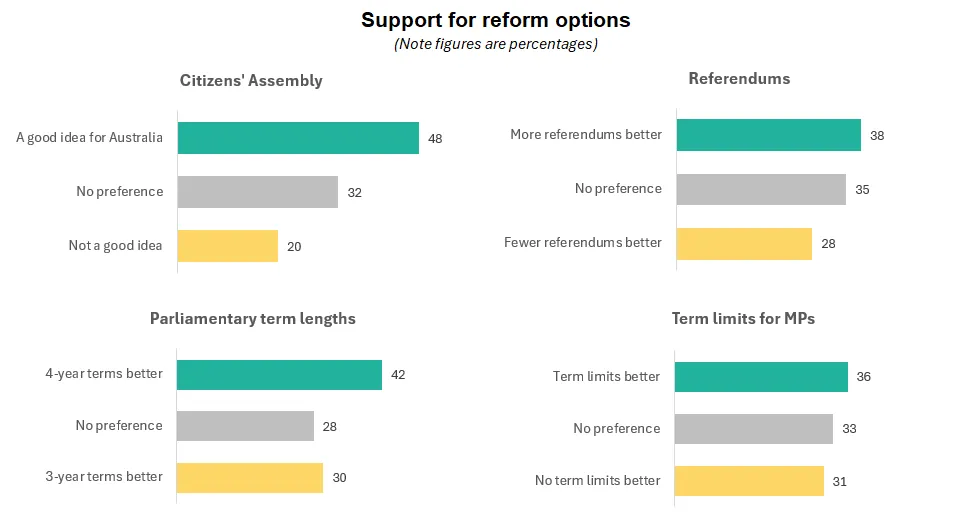
Figure 1: Responses to the four democratic reform options polled in the Australian Election Study. Source: AES 2025
Australian State- and Territory Governments also grapple with the issue of declining trust in government. It is against this backdrop that the Victorian parliament recently completed an inquiry into the voting system for state Upper House elections in 2025.
Currently the Vic Upper House has 40 members, elected from 8 regions. Each region elects five house members.
There are five metro regions and three regional regions.
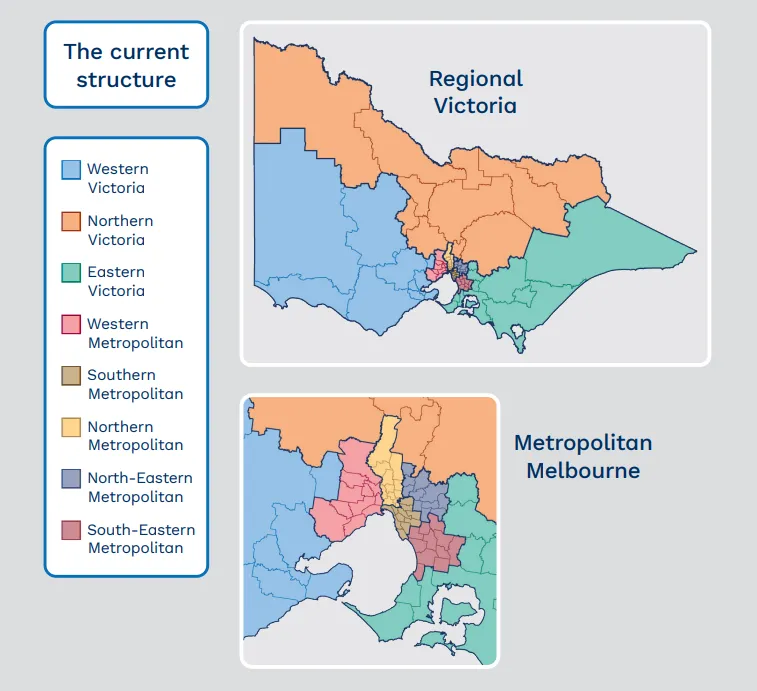
Figure 2: Victorian Upper House Voting Regions. Source: Victoria’s Upper House Electoral System Discussion paper (Oct 2024)
The Vic Parliament inquiry discussion paper considered several reform options for the Upper House.
The two most popular options were:
1. Retain a 40-member state Upper House, but with all members elected from the state as a whole (getting rid of regions), with all 40 members elected at every election
• This results in a quota of 2.4% (the portion of votes a candidate needs to be elected)
2. Retain a 40-member state Upper House, but with all members elected from the state as a whole, with 20 members elected at each election (8-yr terms)
• This results in a quota of 4.8%
As the discussion paper explains: “To be elected in the current structure [with eight regions], a candidate must receive 16.7% of the vote, either through first preference votes or through the flow of preferences. This is called the ‘quota’. The lower a quota is, the fewer votes a candidate needs to be elected.”
Lowering the quota makes it easier for a candidate to get a member elected, ceteris paribus.
The inquiry’s final report put forward three potential approaches for reaching agreement around a future electoral system for the Upper House, before putting it to a referendum: (1) an expert panel, (2) a citizens’ assembly, or (3) a constitutional convention.
The inquiry’s intent is that this process would consider the options and aim to arrive at a consensus approach which would need to be put to a referendum to change the electoral process.
2. Our Plan
3. The Evidence
There is not strict “right” and “wrong” when it comes to considering electoral systems. Larger electoral areas may lead to lower quotas, but the result is that elected officials are expected to represent constituents from much larger regions. And while lower quotas may result in more diverse representation, this diversity could at times make it more difficult for the Upper House to reach agreement on issues.
This Dec-2025 article in the Guardian evaluates the potential reform options proposed by the inquiry. As shown below, the article explains that Option 1, moving to a 40-member Upper House elected on a statewide basis, would result in a lower quota of 2.4% and as such, would be expected to result in a more diverse Upper House than we have currently.
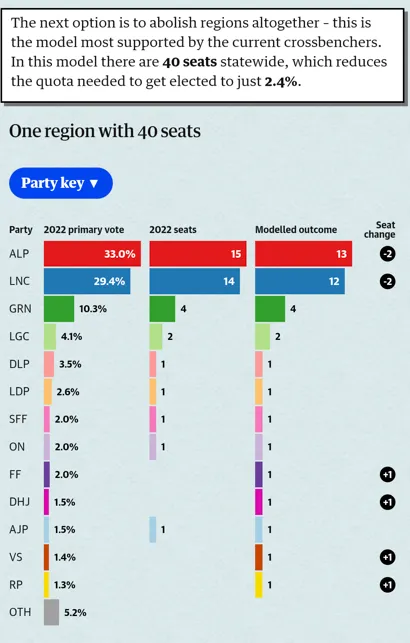
Figure 3: Modelled voting outcomes under statewide proportional representation. Source: Guardian Australia. 2-Dec-2025. Voting in Victoria is broken. Here’s how it could be fixed and who would benefit.
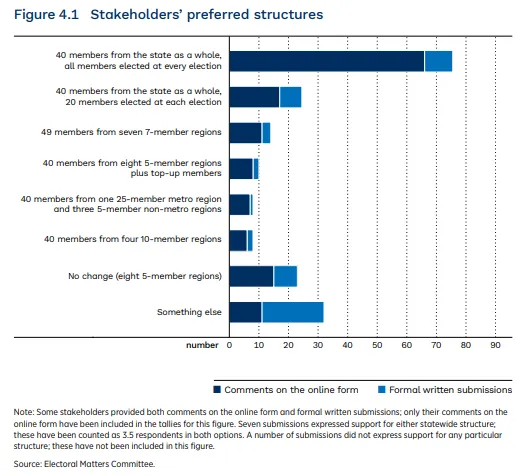
It is also helpful to consider the views of stakeholders who responded to the inquiry. The inquiry’s final report showed that Option 1 was by far the most preferred option, supported by around 3 times as many respondents as the next most preferred option.
4. Conclusion
Trust in elected government has declined significantly in recent years, and voters increasingly express dissatisfaction with a political system dominated for many decades by two parties. This dissatisfaction manifests itself in growing support for minor parties and independents. However, because of our preferential winner-takes-all voting system this voting pattern does not translate into growing representation in seats in parliaments, and this, in turn, adds to dissatisfaction with a system increasingly viewed as broken, ‘rigged’, and in desperate need of overhaul.
Those benefitting from the current system will resist change and resort to the usual ‘why fix it if it’s not broken” argument. However, the question we should be asking is “can we afford not to change the system.” The risk of ‘muddling through’ with an outdated system—a system increasingly viewed as ‘rigged’ and benefitting the established mainstream parties at the expense of minor parties and independents—is creating further disappointment, and increasing risk of voters feeling alienated and radicalising.
This is why we, the Australian Democrats, support adopting proportional representation for Victoria’s Upper House.
5. Let us remember
The late Sid Spindler, former Australian Democrats Senator for Victoria, campaigned for reform of the voting system for the Victorian Legislative Council. He lobbied successive State governments for a system of proportional representation. Such a system introducing eight multi-member regions was adopted by government in 2003 and remains the system we have today. It was expected at the time that further reform may occur in the following years, however this did not come to pass.
6. References
2025 Australian Election Study. ANU and Griffith University. (November 2025)Inquiry into Victoria’s Upper House electoral system, Parliament of Victoria, 2 December 2025.
A House of Review: The role of the Victorian Legislative Council in the democratic process. A Discussion Paper. Constitution Commission of Victoria (August 2001).